A Late-Autumn Walk for Reading the Field Edges
A late-autumn walk for reading the field edges helps you notice seasonal change in hedges, ditches and margins while staying safely on public paths.
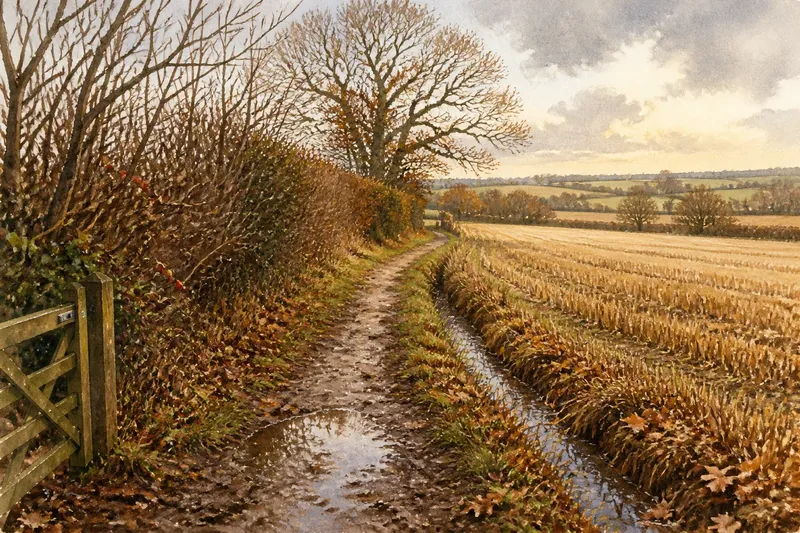
A late-autumn walk for reading the field edges is most revealing when you revisit a familiar public path and notice what the season has changed. Bare branches expose the hedge’s shape; cut crops open a wider view across the fields; rain can turn a once-subtle channel into a dark line of water. The point is to follow these seasonal clues without leaving the route.
Choose a route with a clear seasonal contrast
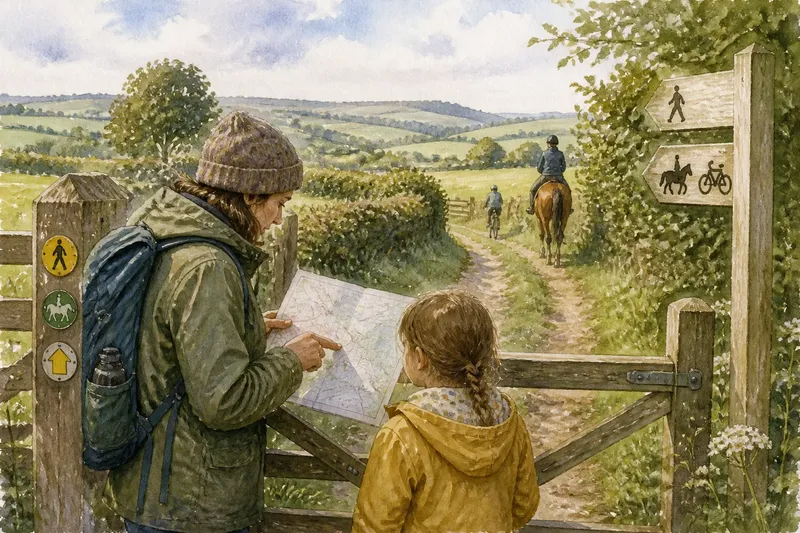
Pick a recognised public footpath that passes fields you know from another time of year. An Ordnance Survey map or a local council rights-of-way map can help confirm the route and its access points. A short out-and-back walk is useful because you can compare the same view on the return without having to keep searching for the next turn.
Check a current map before setting off, and stay on the marked route. A path beside a hedge does not give permission to enter the hedge, field or farm track. Follow local signs, leave gates as you find them and turn back if the route is closed or cannot be passed safely. Wear footwear suited to wet ground and carry a map, with an offline copy on your phone if useful.
Choose a day when the view is clear enough for observation. Low winter light can make a hedge’s outline stand out, while rain or mist may hide details; after heavy rain, a path can become slippery or flooded. Treat the weather as part of the day’s record, not as a reason to press on when the ground is unsafe.
Notice what late autumn has changed
At a familiar stretch, compare the scene with what you remember rather than trying to identify every plant. Is the hedge more open now that leaves have fallen? Has a cut or a gap altered its outline? Are the field’s stubble, bare soil or remaining crop easier to see from the path?
Look for seasonal details at a respectful distance. Hawthorn may carry red berries, dog rose may hold hips, and ivy may retain leaves after nearby branches have emptied. Fallen leaves collect at the hedge base, while grasses and seed heads may remain standing in the margin. These observations describe what is visible; they do not establish how or why the boundary is managed.
A pocket notebook can hold a few words about the view, and a simple sketch can capture the line of a hedge or the position of a bare patch. If you use a phone, keep it brief and avoid blocking the path. Binoculars can help with distant birds, but there is no need to approach a hedge or ditch for a closer look.
Read the weather in the landscape
Late autumn makes recent weather easier to notice in some places. Water may gather in a low stretch of path, leaves may be pressed against a ditch bank, and wet grass may darken where the ground dips. Look from the path rather than stepping towards soft or slippery edges.
Wind can alter the feel of the same field edge. A sheltered section under a dense hedge may sound quieter than an open stretch, where dry stems move against one another. Pause long enough to notice that contrast, but do not interpret it as evidence of a particular farming practice or wildlife presence.
Think of a field margin as the frame around a picture: its shape affects what you notice beyond it, even when the frame itself is not the main subject. In winter, a low hedge can open the view across stubble; a leafy or overgrown section can screen it. The changing view is itself a useful seasonal observation.
How can you make a return visit useful?
What should you bring on a late-autumn walk?
Take a current map, suitable footwear, weather-appropriate layers and something for short notes. Binoculars are optional, and a phone with an offline map can supplement rather than replace route awareness.
How can you watch birds without disturbing them?
Observe from the public path and keep a respectful distance from hedges and ditches. If birds move away or your presence interrupts their activity, continue walking quietly rather than following them.
What should you do if the path is muddy or blocked?
Use a signed alternative route if it is available and clearly suitable; otherwise, turn back. Do not cross a field, climb a fence or follow a ditch to get around an obstruction.
What should you compare on a later visit?
Choose a few visible details to revisit, such as the hedge outline, the amount of standing vegetation or whether water is present in a ditch. Note the date and weather too, so the comparison stays tied to the conditions you actually saw.
Make a concise record of the seasonal view
Imagine you reach a bend where a familiar hedge has lost its leaves and a strip of stubble is newly visible beyond it. You note the bend on your map, sketch the hedge as an uneven line, and write “red berries near the gate; water in ditch after rain”. On a later visit, you can check whether the berries remain, the ditch is dry or the field view has changed, without assuming that one observation explains the whole landscape.
Keep each note specific to its place and date. A useful record might name the public path, describe one change in the hedge or field, and mention the weather that shaped the view. That makes a late-autumn walk for reading the field edges easier to compare with another season, while keeping the walk quiet, safe and within the route.