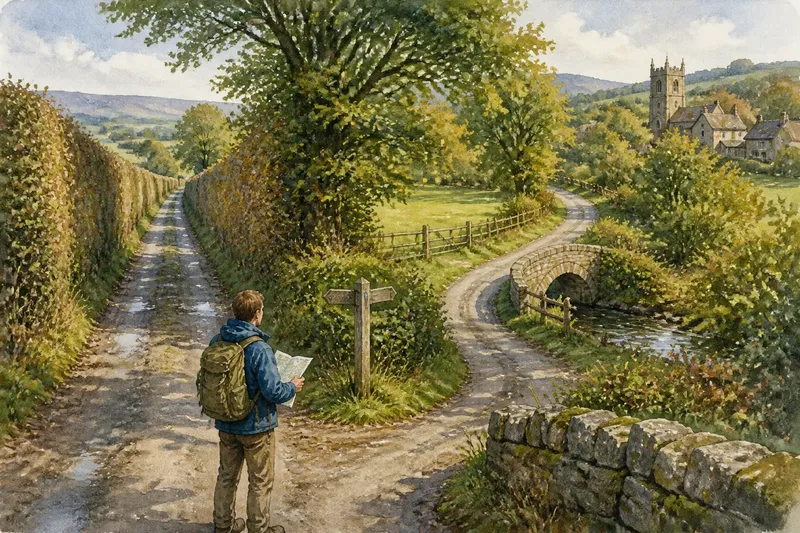
Footpath or Bridleway: What Changes Underfoot?
Footpath or bridleway choices affect access and shared use. Learn how to read route status, anticipate the ground and choose a walk that fits your party.
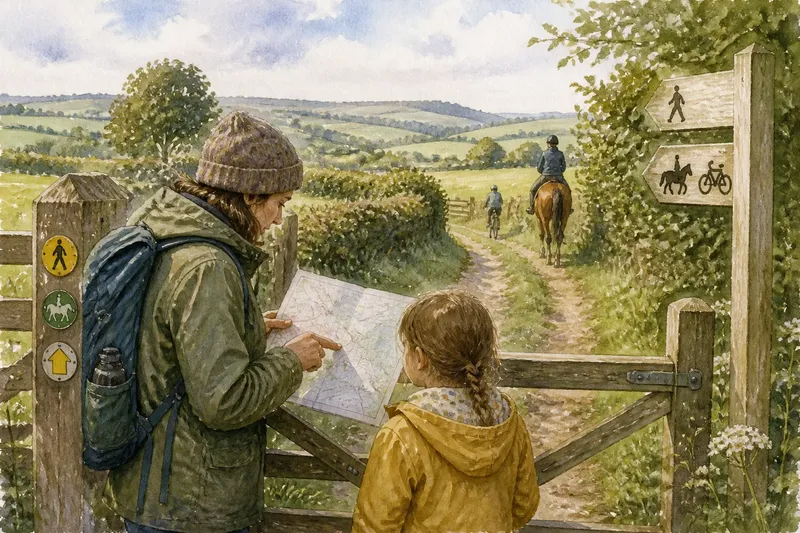
A footpath or bridleway changes who may use a route, not what its surface will be. In England and Wales, that distinction matters when you are choosing a walk, reading a waymark or deciding whether a bicycle belongs on the track.
A footpath gives pedestrians a public right of way; a bridleway gives rights to pedestrians and horse riders, and generally to cyclists under the relevant highway law. Local restrictions, temporary closures and the precise status of a route can affect access, so confirm uncertain routes with the local authority rather than relying on their appearance.
Route status is different from surface
A line on an Ordnance Survey map or a signpost can help identify a route, but width and condition do not establish its legal status. A footpath may be broad and firm; a bridleway may be little more than a grassy line beside a hedge.
In England and Wales, cyclists may use a public bridleway as a right of way, subject to restrictions that apply to the particular route. Cycling is not a right of way on a public footpath. Other arrangements, such as permissive access, may allow additional uses, while local orders can restrict access. Scotland has a different access framework, so these route categories should not be treated as a complete account of access there. Check signs and local authority information where the position is unclear.
Think of the map as a label on a jar: useful for identifying what is inside, but not a description of its texture. The ground itself may be grassy, stony, muddy or paved, and can change with weather and maintenance.
Footpaths bring the field edge close
A footpath may pass through a kissing gate, cross a field, or follow a narrow strip between a hedge and a ditch. Such routes often make the details of the landscape noticeable: a worn stile rail, a change in slope, or a view opening between trees.
That close scale can suit a walk with pauses, but it does not mean the route is easy underfoot. Grass can hide uneven ground, and a shaded hollow may stay slick after rain. Check the mapped route and signs for gates, stiles and road crossings, then choose footwear for the conditions you expect rather than for the word “path”.
Bridleways are shared routes
Bridleways accommodate more than walkers. A horse or bicycle may come along the same stretch, and a narrow track can make passing a matter of courtesy and attention rather than speed.
If you meet a horse, stay calm, give the rider time to see you and follow any request to pause or move aside. Keep a dog close and under control. On a shared route, making room and avoiding sudden movements helps keep the encounter straightforward.
A bridleway can be useful to a cyclist, but its legal status says nothing about whether the surface suits a particular bike or rider. Steep slopes, loose stones and deep mud may call for a different route or for turning back. Walkers may also prefer a footpath if they would rather avoid the possibility of meeting horses or cyclists.
Match the route to the people and ground
Choose with the actual demands of the outing in mind: who is coming, what they can comfortably manage, and whether shared use or awkward surfaces would be a concern. A map can show the route’s line and access points; local signs and visible conditions can clarify what the map cannot.
- Route status: Check the map and local signs. If the route is marked as a footpath, plan for walking only unless separate permission is clearly indicated; if its status is uncertain, check with the local authority or choose a confirmed route.
- Gates and stiles: Look for access points on the map and at the entrance. If a stile would be difficult for someone in your party, choose a route with a suitable gate or an accessible alternative.
- Surface: Check recent conditions where reliable local information is available. If the route is muddy or uneven, choose footwear and a path that your party can manage, or select another route.
- Shared use: Check whether the route is a bridleway and consider who is walking with you. If a dog may not stay close around livestock or riders, choose a quieter route or keep the dog on a lead where appropriate.
- Road crossings: Mark crossings on the map before setting out. If a crossing feels unsuitable for your group, choose a route that avoids it rather than assuming the path continues safely across.
- Changing conditions: Check the weather and note a way back to a familiar point. If the ground or visibility makes continuing uncomfortable, return by the known route or use a suitable alternative.
Imagine you are planning a morning walk with a child who likes stopping to watch hedgerow birds. Your map shows two possible loops: one uses field footpaths with several stiles; the other follows a bridleway and crosses a road. You expect the child to manage gates but not stiles, and you do not want to cross that road. You check the local map and signs, then choose a confirmed footpath loop with gates instead. The trade-off is a shorter outing with more pauses, rather than a longer circuit that conflicts with the group’s needs.
What should you check before choosing a route?
Is a bridleway always wider than a footpath?
No. Route width and surface vary, and neither reliably identifies legal status. Check the map and signs rather than judging by appearance alone.
Can you cycle on a public footpath?
In England and Wales, a public footpath gives a right of way to pedestrians, not a general right to cycle. Check for separate permission or a different route designation, and consult the relevant local authority if the status is unclear.
Does a bridleway make a better choice after rain?
Not necessarily. A bridleway may be muddy or uneven, just as a footpath may be firm; look for local condition information and be ready to choose another route if the ground is unsuitable.
What should you do when a horse approaches?
Stay calm, keep your dog close and make room for the horse and rider. Follow the rider’s request if they need you to pause or move aside.
Read the route before setting out
Footpath or bridleway is a useful distinction, but it answers only part of the planning question. Check who has a right to use the route, then look separately at its surface, access points, crossings and likely company.
Where the legal status or local restrictions remain uncertain, use the local authority’s rights-of-way information or choose a clearly identified alternative. That small check can prevent a pleasant field-edge walk from turning into an avoidable disagreement over access.